MARINE AUTONOMY
Coordination beneath the surface.
Ocean-observing vehicles operating with fewer reliable signals and stricter energy limits.
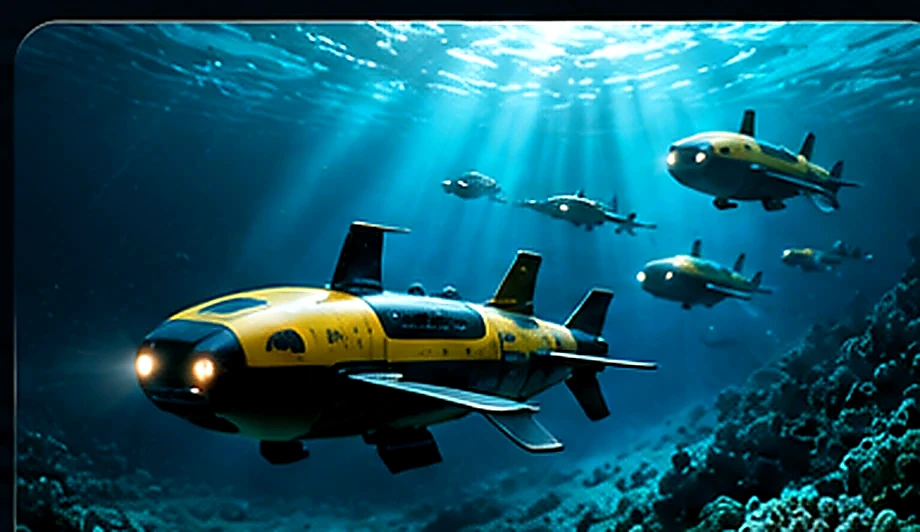 Illustrative technology scene
THE APPLICATION CASE
What the collective can change.
Unlike airborne robots, underwater systems cannot count on routine GPS reception or high-bandwidth radio links. Multi-vehicle observation may combine acoustic communication, onboard navigation, local sensing and scheduled data exchange to cover larger areas while limiting vessel support.
“Invisible” here describes behind-the-scenes coordination or less intrusive system operation; it is not a promise of undetectable equipment, field-proven performance or an existing InvisibleSwarm product.
THE COORDINATION CHALLENGE
Engineering that cannot be skipped.
- Acoustic links with latency, low bandwidth and dropped packets
- Relative localization where GPS is not available underwater
- Long-duration power management, safe recovery and failover
WHERE VALUE MAY FORM
Commercial directions.
- Ocean observation and multi-vehicle mapping
- Environmental and habitat surveys
- Inspection concepts for undersea infrastructure
THE REALITY CHECK
Precision earns trust.
Much of the underwater swarm literature is still simulation-led. Reliable operations need validated underwater communications, navigation, retrieval and environmental safeguards.